.svg)


1. The Hook: Why the World's Toughest Job is Going High-Tech
Mushroom farming is a mechatronic nightmare. Inside an Agaricus farm, the environment is a hostile cocktail of high humidity and elevated CO2 levels. For laborers, it is a "back-breaking" reality of repetitive strain for 10 to 12 hours a day. While automation has been attempted since the 1970s, the path is littered with a "graveyard of failed companies." Most failed because they attempted to force farms to redesign their entire infrastructure to accommodate the machine.
Mycionics, an ag-tech firm born out of Whitecrest Mushrooms in Ontario, took a different approach. The company was founded when Murray Good, a visionary farmer, approached the university as a "man with a problem." Alongside financier Doug Wagner and engineer Stefan Glibetic, the team "earned their stripes" in the beds. This wasn't a laboratory exercise; for a decade, the engineering team worked out of a closet-sized office on the farm. If the robot failed during a night shift, the engineers stayed up to pick thousands of boxes by hand. This visceral understanding of the task led to a fundamental design philosophy: technology must fit into existing farm infrastructure, not the other way around.
2. The Counter-Intuitive Pivot: Why 100% Automation Was the Wrong Goal
In 2022, Mycionics reached a strategic crossroads. While their 30th-generation machine could technically pick a mushroom, the industrial economics didn’t scan. The system was only spending 40% of its time picking; the remaining 60% was "wasted" on navigation, level-to-level transfers, and scanning. Stefan Glibetic and his team realized that chasing a 100% robotic solution was a trap.
The breakthrough was a pivot to a "Hybrid" model: a 75% robot and 25% human split. This model leaves high-value tasks—quality management, thinning, and climate control—to humans, while robots handle the grueling repetition. This makes the mushroom industry uniquely attractive for automation. Unlike seasonal crops that only offer a 12-week harvest window, mushrooms are a 24/7, 365-day business. This constant production allows robotic systems to pay for themselves far faster than in any other agricultural sector.
"A robotic system [that attempts to handle 100% of the labor] will simply be too complex, costly, and practically limiting, leading to an economically unsustainable solution," explains Glibetic.
3. Fingers, Not Suction: Solving the Fragility Problem
The core of Mycionics' success lies in mechatronics—the synergy of mechanical engineering, electrical engineering, and software to solve physical touch problems. In the mushroom world, the "touch" is everything. Mushrooms lack a protective skin like an apple or potato; they are incredibly sensitive.
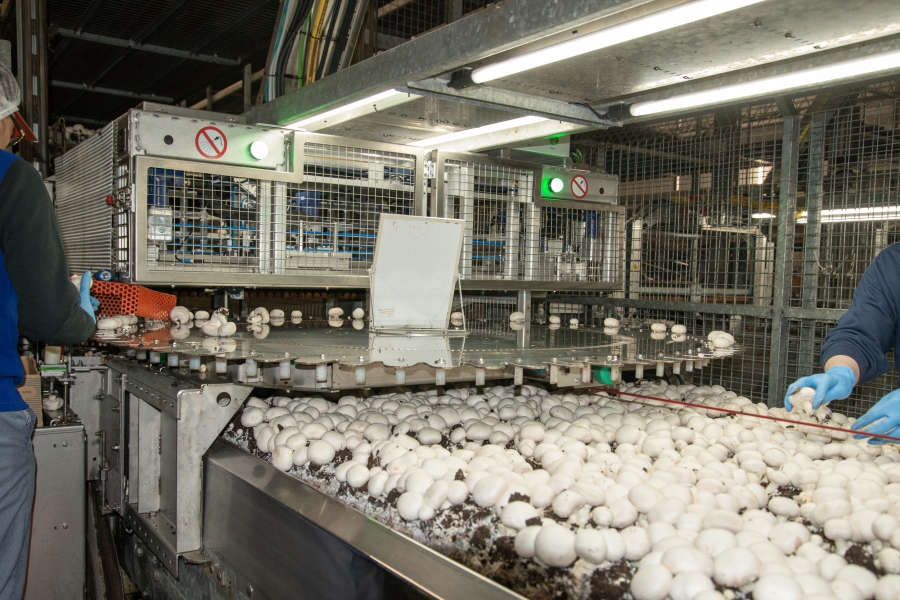
Early in their development, Mycionics experimented with suction cups but quickly abandoned them. Suction creates circular bruises that appear in the fridge after 2 days, damages "feathered" skin, or worse, pulls the cap clean off the stem. To meet "fresh market" standards, Mycionics chose the more difficult path of mechanical fingers. By replicating the human-like touch through complex robotics, they ensured that every mushroom remains retail-ready, regardless of quality fluctuations in the bed.
4. The 18% Yield Boost: Data as the Secret Ingredient
While the robotic arms provide the muscle, the "eyes" of the system—the Pointing and Vision modules—provide the intelligence. These modules can detect pins as small as 4mm and scan the growing beds at a rate of 10 meters per minute. This allows the system to track a mushroom’s entire lifecycle from "pin to pick."
The data allows for "grazing harvests," where the system operates across multiple shifts to pick each mushroom at its absolute peak weight. By optimizing the "order of operations"—directing the harvest sequence to start at level 6 rather than level 1, for example—farms see a 15% harvesting efficiency gain. The financial impact is profound: pilot data shows an average yield improvement of 5–10%, with some high-quality farms hitting an 18% boost. Furthermore, the system provides a precise 5-day production forecast, allowing for better labor and logistics management.
5. Economic Realism: The Two-Year Payback
To survive the rigors of a commercial farm, Mycionics moved from their "closet" beginnings to a dedicated robotics lab at the back of Whitecrest Mushrooms, growing to a team of 20 staff. They replaced plastic components with washdown-friendly stainless steel and aluminum to withstand high-humidity cleaning protocols.
The shift to a hybrid model also changed the labor reduction math. In drawer farms, the four-arm system achieves roughly 80 picks per minute, reducing manual picking labor by 75%. In traditional shelf farms, Mycionics uses a "Blue Belt" conveyor solution: humans pick onto the belt, and the robot handles the precision packing at the end of the line. This configuration reduces labor by 50% while ensuring perfect presentation and minimal weight giveaway. This operational realism results in a ~2-year payback for picking/packing systems and a less than 1-year payback for pointing modules.
6. Conclusion: A Turning Tide
With $20 million invested and major orders now deploying in Canada and Ireland, Mycionics is no longer a laboratory experiment—it is a global player. The industry tide is finally turning because the technology has finally met the farmer on the farm’s own terms.
As we look toward the future of global food security, Mycionics’ success raises a fundamental question for all of Ag-Tech: Is the hybrid human-robot model, rather than total automation, the ultimate blueprint for transforming the world’s most difficult agricultural sectors?
Curious to learn more? Check out our Resources page.
.svg)

.svg)


.svg)
.svg)

