.svg)


1. The Harvest Paradox: Why Traditional Infrastructure is Breaking
The mushroom industry has reached a structural impasse. For decades, production has relied on a manual harvest model that is as grueling as it is intellectually taxing. Whether operating within the "least efficient" wooden infrastructure—where navigation is entirely manual—or modern Dutch aluminum shelving, the fundamental problem remains: we are trying to solve a 21st-century labor crisis with 20th-century infrastructure.
While Dutch shelving introduced metal trolleys and automatic floor lorries to allow a minor degree of task parallelization (moving while scanning), most operations are still tethered to a model where the worker must navigate to a fixed crop. This approach has reached its biological limit. When the growth rate of the crop outpaces the physical capacity of the workforce to navigate and decide, the system collapses. To survive, the industry must transition from "people running around" to a structured, assembly-line environment.
2. The Efficiency Killer: The Tyranny of Serial Tasks
The primary bottleneck in harvesting is the "serial" nature of manual labor. A human harvester currently performs an exhausting string of linear tasks that consume significant "non-productive" time. This includes navigating to rooms, communicating with harvest managers, preparing materials, finding targets, harvesting, cutting stems, quality checking, packing, weighing, and swapping out full stacks for empty boxes.
True efficiency requires parallelization—the ability to perform multiple tasks simultaneously. While a picker might scan for the next mushroom while processing the current one, they cannot physically unload boxes while packing. This serial constraint is the ceiling of human productivity.
"A picker can scan to see which mushroom they’re going to pick next while they’re processing the last one... but they can’t be unloading boxes while packing at the same time."
3. The "Drop-in" Robotics Trap: An Economic Warning
Many producers seek a "drop-in" robot—a machine designed to mimic a human within existing, unmodified infrastructure. This is a dangerous strategic trap. Even a technically successful robot, such as the system pioneered by Mycionics in 2022-2023—the first to successfully scan, pick, cut, and pack in Dutch infrastructure—eventually hits a wall of complexity and cost.
The "trap" is that a robot mimicking a human in a traditional environment cannot keep up with the biological growth rate of the mushrooms cost-effectively. Attempting to force mobility and high-dexterity tasks into a confined, traditional space results in a subpar, high-maintenance system. If the robot cannot survive its ROI period because it is slower than the crop's growth, the farmer faces a high risk of bankruptcy.
4. The Stepping Stone: The 50/50 Split Solution
For farms not yet ready to abandon traditional Dutch shelving, a critical "middle path" exists: the 50/50 Split Solution. Rather than replacing the picker with a complex mobile robot, the farm implements a conveyance system within existing aisles.
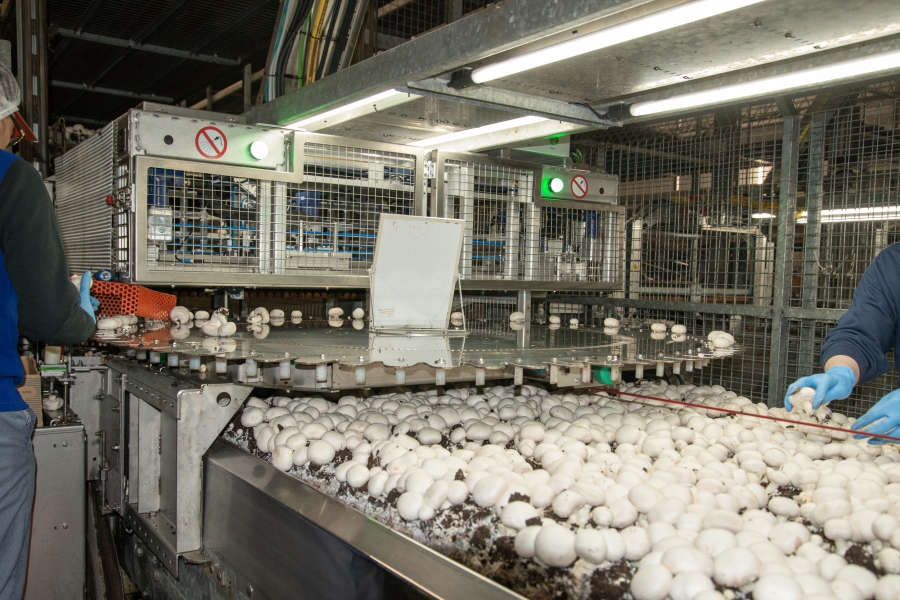
In this model, humans focus exclusively on picking, conveying uncut product with stems oriented downwards to a centralized hallway. Stationary robotics then handle the cutting and packing in a controlled environment. This simple application of parallelization halves the human labor requirement and doubles harvest throughput without a total infrastructure overhaul.
5. Stationary Harvesting: Move the Crop, Not the Worker
The ultimate evolution of AgTech is the transition to Stationary Harvesting Platforms. Systems like "Christian’s drawer system" move drawers of mushrooms through stationary stations, completely eliminating the "navigation" task for both humans and robots.
By moving the crop, we eliminate the non-productive time lost to travel and the mechanical complexity of mobile robotics.
Traditional Navigation-Based Harvesting
Stationary Harvesting Platforms
6. The 80/20 Strategic Partnership
The goal of automation is not total human replacement, but the optimization of human dexterity. Designing robotic grippers to manage tight, unseparated clusters is a technical and economic burden. A more viable strategy is the 80/20 split (ranging from 75/25 to 80/20).
In this model, robots handle the repetitive, high-volume tasks of picking pre-separated, regular-sized mushrooms. Humans are reserved for high-value "stage-setting" tasks:
7. De-skilling the Harvest via Computer Vision
The industry's "skill gap" is actually a data gap. By implementing computer vision as a "Decision Support System," we remove the subjective burden from the harvester. The "Green Dot" system identifies the optimal target for picking based on mass improvement—deciding to "skip" a mushroom to pick it hours later for higher weight.
This level of mass improvement is impossible for a human brain to calculate across thousands of units simultaneously.
"Computer systems can... retain memory of the crop significantly better than humans are able to do."
8. Conclusion: Vertical Optimization and the Assembly Line
The mushroom industry is at a crossroads that mirrors the automotive transition of the early 20th century. Just as Henry Ford replaced "people running around with parts" with a structured assembly line, the mushroom farm must transition to a data-driven, stationary cell model.
This is not just about picking; it is about vertical supply chain optimization. A digitized harvest allows for precise Quota Generation and Logistics Forecasting. We can now know exactly what will be on a truck 24 hours in advance, with a traceability chain that tracks every unit from Tunnel -> Compost Hall -> Bed -> Shelf. This level of control increases shelf life, ensures safety, and secures the farm’s economic future.
The future of the mushroom harvest is not about picking faster; it is about organizing smarter.
Curious to learn more? Check out our Resources page.
.svg)

.svg)


.svg)
.svg)


