.svg)


1. Introduction: The Mushroom Curve
On a particularly foggy morning, where visibility is zero and the road ahead is a wall of grey, one finds the perfect metaphor for entering the mushroom industry. To the uninitiated, it is a quiet, low-tech sector hidden in the dark. To those on the inside, it is a high-speed, mathematically intense race against biology.
Industry veterans call it "climbing the mushroom curve." It is a steep, multi-month learning path where compost chemistry, climate control, and rapid-fire logistics collide. In this world, the shift from traditional "art" to Technical Dominance is no longer a luxury; it is the only way to manage a crop that lacks a pause button. This article reveals the hidden math that dictates farm profitability and why industrial mushroom cultivation is the ultimate proving ground for biological automation.
2. The 4% Hourly Sprint: Why Timing is Everything
In the world of fungi, the margin between a premium product and a total loss is measured in hours. Mushrooms follow an S-curve growth model: they start slow, enter a phase of "rapid shoot-up," and then taper off. During that peak phase, they double in mass every 24 hours.
When you break that down into the consultant’s "hidden math," the numbers are staggering. A mushroom grows at a rate of approximately 4% in mass and 2.5% in diameter every single hour.
"The mushroom grows very quickly... it’s actually more about 4% an hour approximately in mass and about 2 1/2 percent an hour in diameter." — Stefan Glibetic
For a farm manager, this creates a 24-hour pressure cooker. Missing a harvest window by just three or four hours isn't a minor delay—it's a compounded loss of mass and quality. Because growth is constant, the "math of the hour" is the difference between hitting a peak yield and watching your profit margin vanish as the crop overshoots its ideal specifications.
3. The 4 Million Mushroom Problem: Scale and Labor
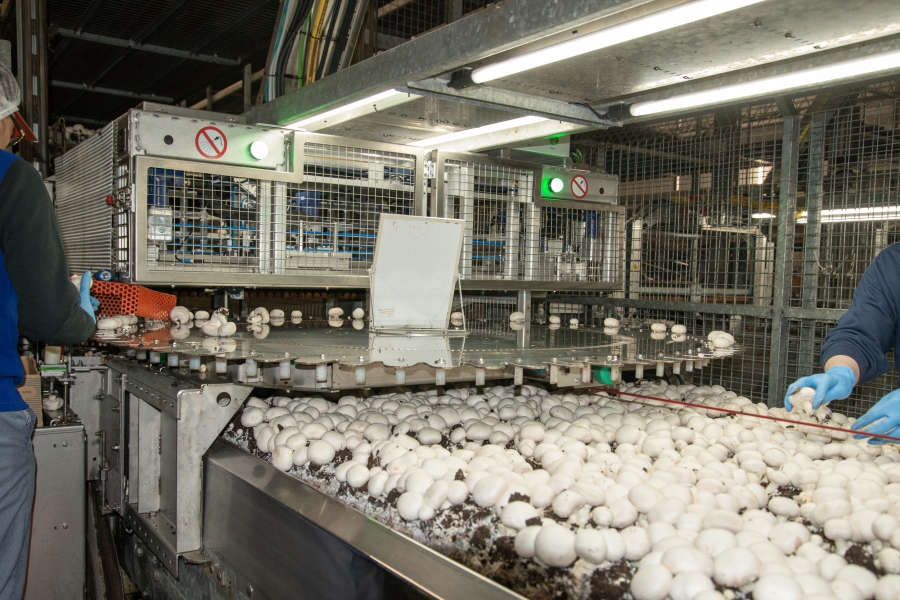
The Staggering Volume of Industrial Yield To understand the logistical friction of manual harvesting, consider a standard high-performing facility. A farm producing 215,000 pounds per week (approximately 100,000 kilograms) is operating at a scale that defies standard agricultural logic.
The Individual Unit Crisis When you translate that mass into individual units, the "Mushroom Math" becomes a nightmare. That weekly yield represents roughly 4 million individual mushrooms that must be identified, selected, and harvested by hand. Each one is a discrete decision-point in a high-stakes game of quality control.
The Loaded Labor Equation To move 4 million units a week, a farm requires approximately 72 people working 45-hour weeks. However, the cost of this labor is significantly more loaded than a simple minimum wage calculation. Because the work is physically demanding and specialized, farms often rely on foreign labor, meaning the "true cost" includes housing, immigration support, and recruitment. When you add the friction of PPE compliance, shift changes, and the constant movement of human pickers, manual labor struggles to keep pace with a crop that never sleeps.
4. The Quality Cliff: The Art of the "Veil"
In mushroom cultivation, there is a fundamental distinction between two tasks: harvesting (the act of removing the mushroom) and separating/thinning (the art of spacing). A grower must maintain a density of 60 to 90 active mushrooms per square foot. If the bed is too crowded, mushrooms "sense" the strain on mycelial resources and accelerate their reproductive cycle, leading to the veil.
The veil is the quality cliff. When the cap opens to reveal gills and release spores, the mushroom transitions from "first quality" to a lower-value product used for canning or slicing.
Market vs. Mass: The Strategic Tension The farmer faces a constant conflict between retailer quotas and yield optimization.
By picking early to satisfy a quota, a farmer sacrifices up to 300% of the potential mass of that individual mushroom. However, by thinning the bed correctly and hitting the absolute peak of the S-curve, the potential for profit is transformative.
"Some farms have run tests... and they've achieved results up to 30-40% yield increases... if you pick the mushrooms at the right time." — Stefan Glibetic
5. The Efficiency Gap: Maximums vs. Averages
There is a massive chasm between a worker’s "maximum" capability and their sustainable "average." While a proficient picker can hit 60+ picks per minute, peripheral tasks—moving trolleys, donning PPE, and calibrating pointing systems—usually cause a 50% efficiency drop, bringing the average down to 20-30 picks.
Infrastructure dictates the math of this efficiency gap:
Robotics represent the move toward Technical Dominance by eliminating the efficiency drop entirely. A robot doesn't suffer from ergonomic fatigue or require shift changes; it maintains the maximum rate 24/7, effectively removing the "pause button" from the harvest cycle.
6. Conclusion: The Future of the Flush
The industrial mushroom farm is evolving from a traditional agricultural site into a high-density data center of biology. Managing a crop that grows 4% every hour requires a level of precision that exceeds human cognitive limits. We are moving toward a future where "Technical Dominance" isn't just about robots; it's about the data science required to navigate the S-curve.
Mushrooms were the world’s original indoor vertical farm—climate-controlled, stacked, and high-density. If they provided the original blueprint for vertical farming, they are now providing the blueprint for the fully automated farm of the future. In an industry where the clock never stops, the only way to stay ahead of the curve is to automate the climb.
Curious to learn more? Check out our Resources page.

.svg)

.svg)


.svg)
.svg)


