.svg)


1. The Hidden World Beneath the Surface
The mushroom is no longer just a humble garnish; it is a biological marvel increasingly recognized as a "designer" meat alternative. Yet, despite its ubiquity, the process of mushroom cultivation has remained an arcane art—shrouded in misunderstanding and governed by the "gut feel" of veteran growers. Mycionics is rewriting this biological script through its CropScout mission. This isn't just automation; it is the digitization of the fungal ghost in the machine, transforming a 30-year-old craft into a high-precision digital science that maps life at the sub-millimeter level.
2. The Umami Bridge: Biological Hardware
Mushrooms occupy a unique culinary space because of umami, the legendary "fifth taste." While often described as a savory flavor, the AgTech perspective reveals something more profound: umami is a biological interaction between the mushroom and our own hardware. As Stefan Glibetic notes, the human tongue is "literally able to taste a protein" commonly found in meats. This protein-sensing capability is why mushrooms are uniquely positioned to anchor the future of plant-based diets. They aren't just mimicking meat; they are triggering the same evolutionary sensors.
3. The 4% Per Hour Growth Race
In the mushroom house, time is the ultimate adversary. White buttons grow at a startling rate of up to 4% to 5% per hour. This rapid metamorphosis creates a high-stakes technical challenge: if a scanning system moves too slowly, the data becomes a "blurry" representation of a reality that no longer exists. By the time a 30-minute scan finishes, the mushrooms at the starting point have already grown nearly 2.5%.
To maintain sub-millimeter accuracy depth maps, CropScout creates a high-resolution XYZ point cloud of the entire bed (scanning roughly 10 square meters per minute) in a window of under 25 minutes. This speed allows for a "digital twin" that remains valid, capturing the exact geometry, height, and position of every mushroom before the crop's morphology shifts.
4. The "Mutant" History and the Labor Stagger
One of the most counter-intuitive facts in agriculture is that the common white button mushroom is a genetic mutation. In 1960s Pennsylvania, white mushrooms appeared as a mutation of brown varieties; growers replicated this "appetizing" fluke until it dominated the global market.
More importantly, the industry differentiates between Portobellos, Creminis, and Buttons—which are often the exact same organism harvested at different life stages. Growers manage this through the "stagger"—the orchestration of different size groups on a single bed. The stagger is a conductor’s tool, allowing a farm to distribute labor by focusing on the largest group today and the next largest tomorrow, maximizing both yield and human efficiency.
5. Validating the "Sniff Test": AI vs. Intuition
For decades, the "Old Guard" of farmers relied on a "sniff test," walking into a room to intuitively detect CO2 pockets or humidity imbalances by the scent of the air and compost. Today, the "New Guard" uses micro-climate mapping and compost topology—monitoring height fluctuations and terrain variations across the bed—to validate these instincts with ground-truth data.
This data doesn't replace the farmer's intuition; it honors it. Stefan Glibetic observes:
"To see the data in the flesh right in front of them, just validate their art, their intuition for the last 30 years, gets them really excited as a validation of their craft... of their art."
Whether it’s a heat map confirming a CO2 pocket in a dead-air zone or a 0.5-degree temperature fluctuation between vertical tiers, the AI provides the "why" behind what the farmer’s nose already knew.
6. The Staggering Scale of 4 Million Picks
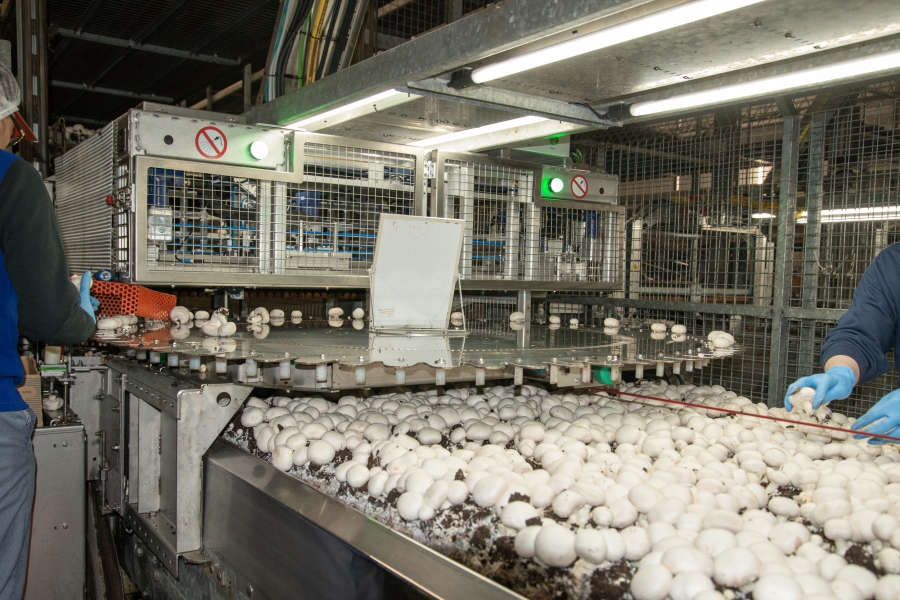
The scale of the industry is immense. A single large farm can hand-pick and process 4 million mushrooms in just seven days. With labor and packaging representing 40% to 50% of production costs, even a 5-10% yield improvement is a bottom-line game changer.
This economic reality is driving a fundamental shift in the human element. We are moving away from the "manual robot"—the worker performing back-breaking, repetitive tasks in high-CO2 environments—toward the "higher-skilled vessel." In an automated facility, the goal shifts from "picking pounds" to "optimizing yield." Humans become managers of robotic systems and precision thunners of pins, focusing on the science of the crop rather than the physical weight of the harvest.
7. Conclusion: Detecting the Reproductive Signal
We are moving rapidly from subjective intuition to objective, sub-millimeter reality. By tracking a mushroom's rate of geometric change, Mycionics can now identify a "reproductive signal"—when a mushroom begins to flatten its cap and stretch its stem to release spores. This signal indicates an imminent valuation crash, as the mushroom prepares to die and loses its market value.
If a machine can now see a mushroom’s biological intentions before they manifest to the human eye, it raises a compelling question for the future of food: What other biological secrets are we currently missing in our fields? As we transition from "sniffing the air" to mapping XYZ point clouds, the future of the mushroom looks less like traditional farming and more like high-tech manufacturing.
Curious to learn more? Check out our Resources page.

.svg)

.svg)


.svg)
.svg)


