.svg)


In the glossy pages of speculative tech brochures, the future of agriculture is a "lights-out" operation: a sterile, silent hall where fleets of autonomous droids plant, tend, and harvest without a human soul in sight. It is a compelling sci-fi vision, but for those standing in the 90% humidity of a commercial mushroom farm, it is a mirage. The reality of the farm is a hostile frontier of corrosive chemicals, flickering LED lights, and high CO2 levels—environments where "perfect" automation doesn't just struggle; it rusts and fails.
The "automation mirage" has lured many into a dangerous financial gamble, holding out for a fully autonomous future that remains at least a decade away. History warns us against this pursuit of the 100% robotic farm. Even Elon Musk famously hit the "automation wall" at Tesla’s Line 3, eventually tearing out millions of dollars in over-engineered robotics to re-integrate the one component that actually worked: humans. The lesson was expensive but clear: absolute autonomy is often an optimization error. The real heroes of the next agricultural revolution aren't solo droids; they are "Cobots"—collaborative robots designed to augment the human worker, not delete them.
Takeaway 1: The Myth of the 100% Robotic Farm
The dream of a human-free farm is more than an optimistic forecast; it is a fiscal trap. Waiting for total autonomy means ignoring the commercially viable "Hybrid Solution" available today. When developers attempt to force off-the-shelf industrial robots into the farm, the costs skyrocket. Stefan Glibetic recalls a quote for a single vision system—just one component of a potential robot—that came in at $140,000. At that price point, the ROI doesn't just move; it vanishes.
The "middle path" of hybrid automation is more viable because it focuses on immediate utility. By using robots to handle the mechanical heavy lifting while keeping humans in the loop for decision-making, farms can achieve an immediate return on investment. This isn't a compromise; it's a strategic optimization that recognizes that robots and humans together are far more effective than either alone.
"Collaborative robots... work at a human pace. If you bump into them or if they bump into you, they stop. Like they stop working. Collaborative robots are actually a really good example of how industry has figured out that using robots with people is actually way more effective than people alone or robots alone." — Jim Beretta
Takeaway 2: The "4 Ds"—Why Mushrooms are the Perfect Robot Candidate
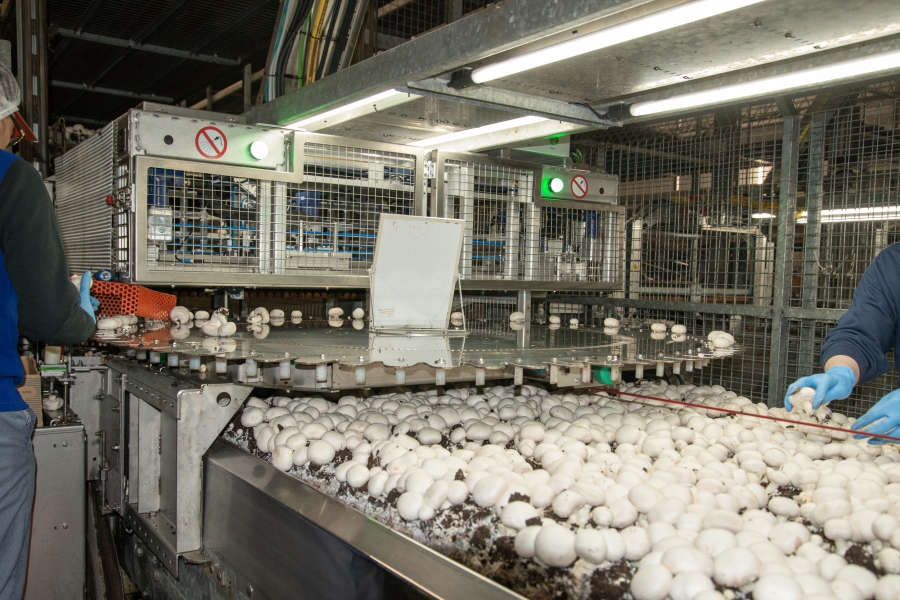
Industrial automation has traditionally targeted the "3 Ds": tasks that are Dirty, Dangerous, or Dull. In the mushroom industry, we add a fourth: Data. Mushroom picking is a grueling, 12-hour-a-day grind in a environment that is essentially a pressurized damp basement. It is a job that the modern workforce increasingly refuses to do.
This has created a systemic labor crisis. Many farms rely on a two-year labor loop: foreign workers take the job to fulfill permanent residency requirements, but the moment their papers are processed, they leave the humidity and high CO2 behind. Automation here isn't about displacement; it’s about worker retention. By handing the most back-breaking, repetitive work to a machine, farms can transform a "terrible job" into a high-tech supervisory role, keeping their human talent from burning out and moving on.
Takeaway 3: The Unbeatable Human Advantage (27 Degrees of Freedom)
Despite the leaps in AI, the human hand remains an engineering masterpiece that silicon cannot yet match for twenty dollars an hour. A human hand possesses 27 degrees of freedom, a level of dexterity required to harvest the Agaricus mushroom without ruinous consequences. These mushrooms are incredibly fragile; a mere brush of a robotic finger can bruise the skin, turning a premium crop into compost-bound waste by the time it reaches the grocery store.
Humans also possess "edge-case intuition" that robots lack. Consider the "pogo stick" analogy from the frozen food industry: when a conveyor jam leaves a gap in an eight-pack of frozen pogo dogs, a human worker simply pulls a spare from their pocket and fills the hole in a split second. A robot would require a $100,000 vision suite and a rewrite of its neural net to handle that same minor hiccup. A human can execute a complex 3-second cycle—pivoting, pushing, pulling, and twisting—with a finesse that no current end-effector can replicate at scale.
"Once the pickers first started seeing the robotics... instead of having a negative reaction, they actually had a positive reaction towards the robot, because then they were like, 'Yeah, make the robot do all the stuff that I don't want to do... the robot can do the dirty work. I don't want to do that.'" — Stefan Glibetic
Takeaway 4: Data as the Hidden Harvest
While the cobots pick, they are also performing a "hidden harvest": the collection of massive data sets. A single scan of a mushroom bed can generate 10GB of raw data, totaling upwards of 100GB per bed, per day. This provides a "bird's eye view" of the crop that is physically impossible for a human to see while standing in a narrow aisle looking at the beds from an awkward angle.
This data enables "Autopilot" harvesting. Instead of picking systematically from the bottom bed to the top, farmers use real-time quality metrics to pivot their strategy. If the data shows that Level 7 is peaking with high-value "ports" while Level 1 is lagging, the system redirects the robots and humans to the highest-value targets first. This shifts the farmer’s role from a manual laborer to a Digital Strategist, managing the farm through scatter plots and histograms rather than sheer physical endurance.
Takeaway 5: The KISS Principle (Keep It Simple, Stupid)
On a farm, "high-tech" is a liability if it isn't "farm-tough." Standard industrial robots often fail because IP67 ratings aren't enough to stop the creep of corrosion from agricultural chemicals. This is why custom, modular solutions win over off-the-shelf complexity. A robot on a farm shouldn't require a specialist flown in from Germany; it should be maintainable by the local manager with a simple Allen key.
The goal is for the robot to be "the least of the maintenance man's problems." By designing modular grippers and simple mechanical interfaces, MyCionics ensures that if a part fails at 2:00 AM, the harvester can swap it out themselves. This philosophy of simplicity—where common tools replace proprietary tech support—is what makes the difference between a working infrastructure and an expensive paperweight.
Conclusion: The Eyes in the Sky
The future of agriculture is a shift from robots-as-replacements to Robots-as-Infrastructure. This is realized through the "Eyes in the Sky" model—a $250/month subscription that provides 24/7 remote monitoring and anomaly detection. It is the ultimate safety net: the manufacturer sees the "signature" of a failing motor before the farmer even notices a stutter, allowing for preventative maintenance that avoids catastrophic downtime.
As our food supply chain becomes increasingly digitized, we are moving toward a seamless partnership where the machine handles the monotonous and the human handles the complex. It forces a final, vital question for the industry:
As data becomes as essential as the crop itself, are we prepared for the day when the most important tool in a farmer’s shed isn’t a tractor, but a digital dashboard?
Curious to learn more? Check out our Resources page.
.svg)

.svg)


.svg)
.svg)

